
DEVASTATION IN THE WAKE OF FLOODS:
Flash floods caused significant damage to Boro crops across the country, as more than six lakh hectares of agricultural land were submerged. Many blamed the floods for the subsequent rice crisis. In June, The Daily Star reported that the country saw 42 percent rise in rice price in a year. The crisis forced the food ministry to take steps to import rice from Myanmar, in spite of strains in bilateral relations due to the recent Rohingya influx.
In addition, floods halted academic activities in thousands of educational institutions in north and northeastern districts, affecting several lakh students.
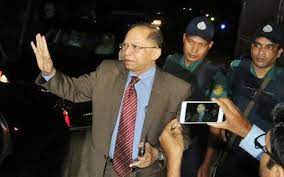
THE SINHA SAGA
Surendra Kumar Sinha, the former chief justice, had been vocal about issues of judicial independence. Throughout his tenure, the relations between the judiciary and the executive branch of government were tense, especially over the issue of the gazette notification on the rules determining the disciplines and code of conduct for lower court judges. (After his departure, in December, the law ministry finally issued the gazette notification, keeping the power to appoint and remove lower court judges in the hands of the president and the executive branch.)
After one month, he did not return as promised to resume his role as chief justice. Instead, he was said to have sent his resignation letter—an unprecedented incident in the history of Bangladesh— from abroad. Meanwhile, the government brought up a number of charges— including corruption, money laundering, and moral aberration—against him. However, the government did not appear to pursue these charges once he resigned.
A NEW PUPPET ELECTION COMMISSION:
As the tenure of the last Election Commission expired in February 2017, a new Election Commission was formed to conduct the next general election to be held in 2019. Twenty-six registered political parties proposed 100 names from which 20 names were primarily shortlisted by the search committee for reconstituting the five-member Election Commission. Subsequently, the new Election Commission was formed on February 6, 2017 and KM Nurul Huda, a former secretary, was appointed as the chief election commissioner.
NO TEESTA WATER-SHARING DEAL:
In April 2017, the prime minister’s visit to India was a disappointment for the people of Bangladesh as the much-delayed Teesta water-sharing deal was not signed. The prime minister went on a four-day state visit to India with the hope of breaking the stalemate on Teesta. However, the deal could not be signed as West Bengal Chief Minister Mamata Banerjee could not be persuaded
BANKING SECTOR IN TURMOIL:
Bangladesh Commerce Bank in 2016, coupled with soaring default loans, which now constitute 10.67 percent of total distributed loans—an all-time high—raised concerns about the stability of the financial sector. The state-owned banks, in particular, are in extreme crisis.
The government also moved ahead with amending Banking Companies Act, extending the tenure of directors and doubling the number of directors in a bank’s board from a single family. A number of economists and bankers, including former deputy governor of Bangladesh Bank, Ibrahim Khaled, criticised the move, saying it would hurt the interest of the depositors, and that the owning families would further consolidate their grip
RAMPAL POWER PLANT: CONTROVERSY NOT SETTLED:
The controversy surrounding Rampal power plant near the Sundarbans continued throughout most of last year. Apart from warnings of dire environmental consequences, a Greenpeace study claimed in May that the plant would cause at least 6,000 premature deaths and low birth weight of 24,000 babies during its 40-year life. Earlier, Unesco had threatened to inscribe the Sundarbans in the list of World Heritage in Danger.
In July, it was claimed, rather misleadingly, that Unesco had “lifted” its previous objections and “endorsed” the construction of the plant. Later, as the official decision came to light, it turned out that Unesco did soften its position, but remained short of lifting its objections. Though it did not specifically mention Rampal plant, it retained its position to not allow “any large-scale industrial and/or infrastructure developments” to proceed before a Strategic Environment Assessment (SEA) was submitted. Later, Unesco made it clear that “large-scale industrial and/or infrastructure developments” included the Rampal plant. Despite the clarification, Tawfiq-e-Elahi Chowdhury, prime minister’s energy affairs adviser, vowed to continue with the plant’s construction. UNESCO’S RECOGNITION OF.
Please support us by visit and share your comments on : https://bdrealissues.blog/ and https://daily-nobojug.com/
What you are saying is completely nonsence. Tomake ekbar voira dimu.
Person like do not deserve to live in this world
Tui voy paish na amra toke find out korbo tar por bujhbi
Tor din shesh hoye asche khub tara tari
jati tor kache jante chay tui kothay achis?